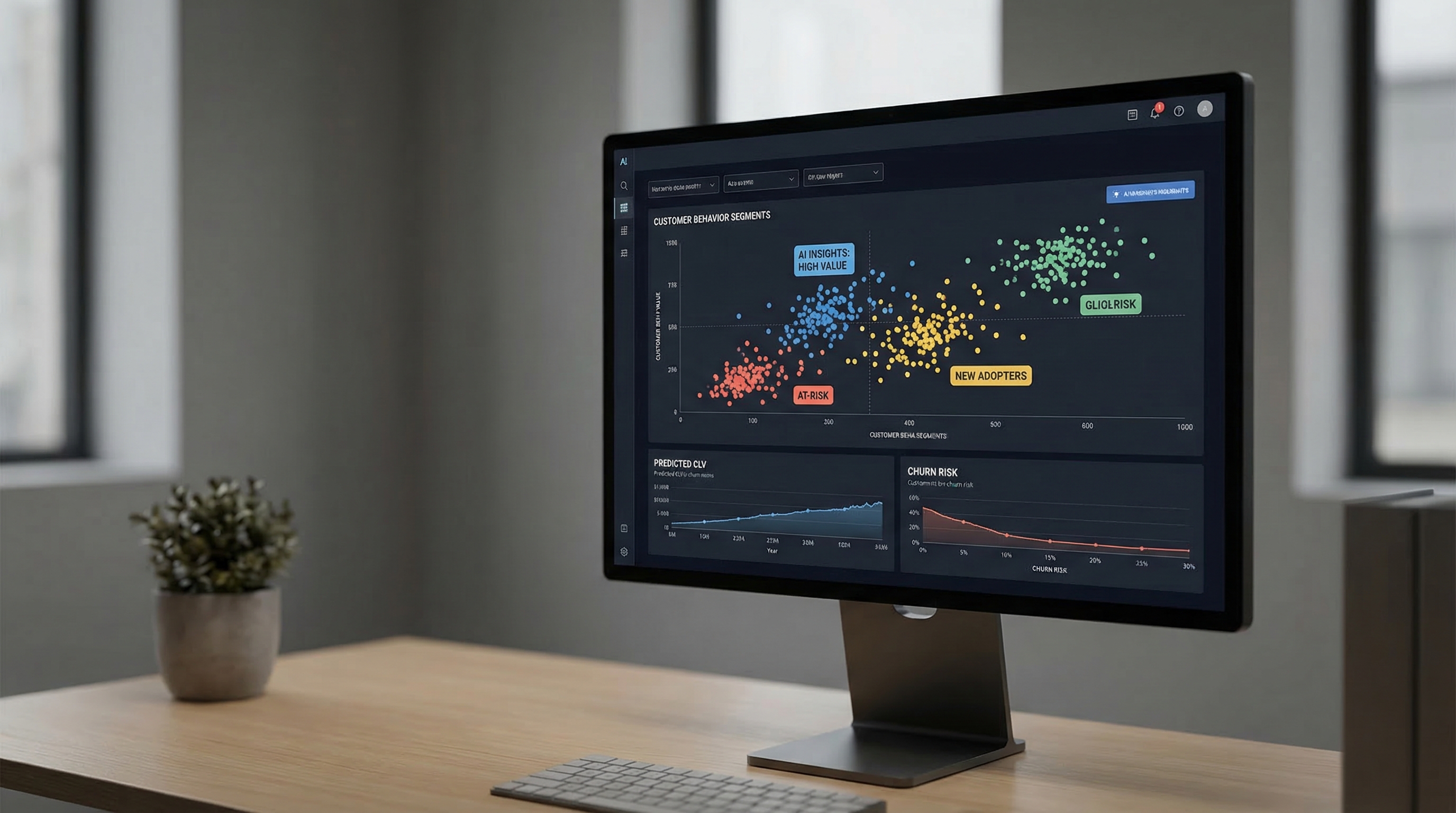
A loyalty program with 340,000 active members. Six segments defined by the marketing team. Then an unsupervised model found fourteen — and three of them generated 41% of incremental revenue.
The starting point
The retailer (a multi-category European chain, ~600M€ annual revenue) had what most CMOs consider a mature CRM: cleaned customer database, RFM scoring, six manually-defined segments ("VIPs," "loyalists," "occasionals," "lapsers," "newcomers," "discount-hunters"). Email campaigns mapped 1:1 to those segments. Open rates were declining 4-6% year over year.
The hypothesis: segmentation was too coarse. The marketing director couldn't articulate why a campaign that worked in March bombed in October — same segment, different month, opposite results.
What we did
We pulled five years of transactional data, browse events, and contact-channel responses. ~1.2 billion rows. Engineered ~80 behavioral features per customer (basket diversity, day-of-week skew, channel preference entropy, return rate, response latency, etc.). Ran HDBSCAN to discover natural clusters without forcing a number.
The model surfaced 14 stable clusters — eight overlapping with the existing 6 segments, six entirely new.
The three profiles that changed the business
Off-peak premium buyers. Bought the highest-margin items, but only between 10pm and midnight on weekdays. Marketing was sending them morning campaigns. Switching send-time alone lifted their revenue 18%.
Cross-category samplers. Bought one item per category every 6 weeks. Looked like "occasionals" by RFM, but their lifetime value was 3.2x the average — they were just slow, methodical buyers. Discount-heavy campaigns were actively suppressing their purchases (they read it as "the brand is desperate"). Removing those campaigns lifted retention.
Stockout-frustrated lapsers. Customers who lapsed after attempting to buy an out-of-stock item three or more times. Existing flow treated them as "lapsed customers" with discount win-backs. The model showed they didn't want a discount — they wanted to know when the item was back. A simple "back in stock" notification re-engaged 34% of them.
Lessons
The team didn't lose to AI. The team had been right about the existing six segments. They just couldn't see the long tail — the customers whose behavior didn't fit the dominant patterns. That's exactly where unsupervised models earn their keep.
What didn't work: trying to explain every cluster. Two of the fourteen clusters looked statistically real but defied marketing interpretation. We let those sit unaddressed for a quarter — and the data eventually showed they were transient (regional promo artifacts). Resist the urge to act on every cluster the model produces.